So, it's election time, the traditional occasion for whinging about the British electoral system, such as it is. No doubt if I cared enough I could find all sorts of telling commentary on this from around the ``'blogosphere'', but rather than making you suffer that I'll quote something posted to NotApathetic:
I live in Nicholas Soames' constituency, Mid Sussex, and even if I could vote as often as a Birmingham Labour councillor it wouldn't move him an inch closer to being thrown out on his ear.
(This also has the pleasing side-effect that, rather than having to to spend a despairing hour Googling for cries of electoral pain from the rest of the UK ``'blogosphere'', I can just find something appropriate with a nice quick database query. On which subject -- I'd be most grateful if my half-dozen readers could help out with the soulless task of helping me cluster comments on NotApathetic -- I can promise you that it might be worth your while.)
Since this gives me another opportunity to expose you to my thoughts on bonkers electoral systems while re-using graphs I've already drawn, I thought I'd weigh in. (Plus, I got an email the other day from Paul Davies of Make Votes Count, asking me to contribute thoughts on this.)
As you will know -- unless you have been remaining in a state of happy ignorance for the past few centuries -- in the UK, MPs are elected on single-member constituencies under a first-past-the-post electoral system. Each elector may vote for up to one named candidate. In the last Parliament there were 659 MPs, and in the next one there will be 646 (following boundary changes in Scotland); the median constituency has about 68,000 electors. Labour constituencies tend to have proportionately fewer electors than Tory ones:
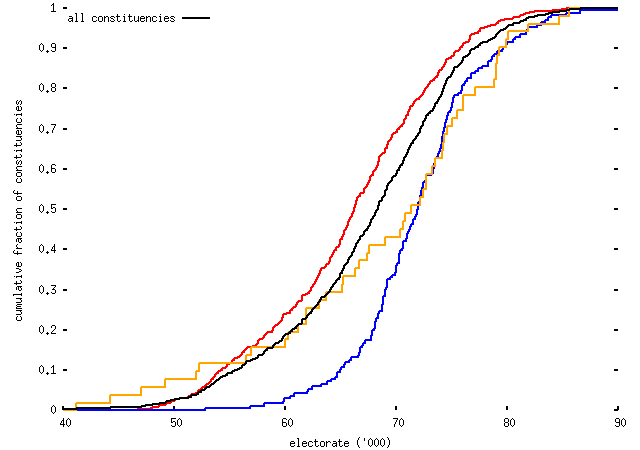
-- I understand (though I have not checked) that this effect is due mostly to quirks of demographics, of which the one most usually advanced is that Labour constituencies tend to be more urban and that, as technology changes, towndwellers are fleeing their lives of urban squalor, and exchanging them for lives of whinging about fox-hunting, driving SUVs down country lanes at break-neck speed, and the other trappings of rural squalor. Apparently the Boundary Commission can't keep up and the result is that the median Labour constituency gets by with only 66,000 electors while the median Tory constituency has about 72,000. This fact, no doubt, warms the hearts of the many Labour MPs who benefit from it.
(At this point I'll interpose a quick trivia question: what simple geographic feature do the constituencies having the largest and smallest numbers of electors share?)
Anyway, most of the alleged faults of our electoral system are summed up in this diagram, which I have posted before:
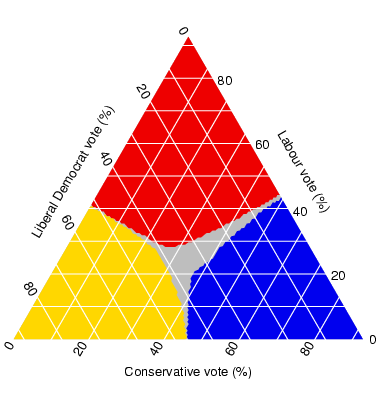
(A re-cap on how to read this: each point in the triangle represents a particular level of support for the three major parties, assuming a constant level of support for other parties. The colour of the triangle at that point shows which of the parties would achieve a majority in Parliament at that level of support, as predicted by a uniform national swing. The grey area shows conditions where no party is in overall control.)
For our purposes this diagram shows two important things: firstly, it is not symmetric under the exchange of any two parties -- the electoral system treats some of the major parties better than others; secondly, there are many points where a minority of support for a given party in the electorate will nonetheless yield a Parliamentary majority for that party.
Many people object to one or both of these features, and propose a variety of systems (usually referred to as `proportional') to replace our current tried-and-testing scheme. On the same type of diagram, such a system would look like this:
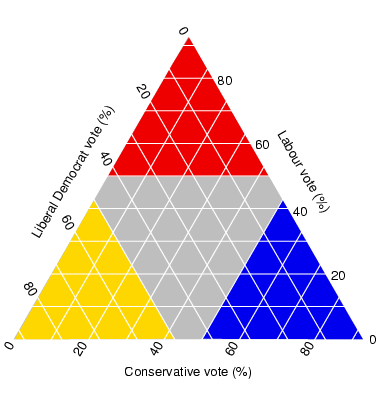
There are two general classes of objection to such systems:
- They break the link between constituent and MP.
- A system of proportional representation would put an end to Labour's Parliamentary majority.
One very sensible argument for the first of these (thanks to Martin Keegan for forcefully articulating this to me) is that an election should be viewed not as an aspirational exercise in the choosing of a future government but as a referendum on the conduct of the previous one. In order to achieve this electors ought to be in a position to sack their MPs. The charming notion here is that politicians will eventually learn by association that they ought not to annoy the electorate too much. Many proportional representation schemes (like the utterly wretched one used in the European elections) rely on a party list; when support for a party falls, the representatives who lose their jobs are those which the party has placed lowest on the list, not those whom the electors think have done the worst job.
Now... rather than discuss the merits of any of the variety of replacement electoral systems which have been proposed, I am going to propose one of my own:
For many advocates of the existing system, the election of single MPs in single constituencies is a requirement that any future system should maintain. My proposal is designed to achieve this, while also managing to be perfectly proportional. Instead of varying the electoral system in the country, I propose that to modify the conduct of divisions in the House of Commons.
Presently, each MP in the Commons gets one vote, and, when the house divides, the side with the largest number of votes wins. (When there is a tie, the Speaker casts a tie-breaking vote, traditionally for the Government.)
Observing that while electors do vote for individual candidates, they typically also care about the candidates' chosen parties, I propose that, rather than giving each MP one vote, we give them a (fractional) number of votes equal to the fraction of the electorate who voted for their party, divided by the number of MPs of that party elected, multiplied by the total number of MPs. As an example, here is how the 2001 election would look:
| Party | Support (%) | MPs | Each MP's vote |
|---|---|---|---|
| Labour | 40.7 | 413 | 0.65 |
| Conservative | 31.7 | 166 | 1.26 |
| Liberal Democrat | 18.3 | 52 | 2.32 |
| SNP | 1.8 | 5 | 2.37 |
| Plaid Cymru | 0.7 | 4 | 1.15 |
For the purposes of mental arithmetic, each Labour MP is worth roughly 2/3 of a seat, each Conservative MP 1 1/4, and each Lib Dem 2 2/3.
(As usual one should be a little cautious in interpreting historical election results translated into novel electoral systems since presumably the electorate's behaviour would change if the electoral system were modified. But the above seems plausible as a rough guide.)
There are various corner cases which one should treat. Independent MPs are easy to handle (treat as single-member parties -- for instance, Dr Richard Taylor would have had a voting weight of 0.71); harder are the cases of parties splitting or merging, or (as a special case) defection of an MP. Obviously one -- attractively simple -- possibility is for an MP to carry their voting weight with them for the duration of each Parliament, but that may not strike the right balance between support for an individual candidate and for their party. Similarly, a by-election can be treated as the election of an independent, or the new MP can be given the voting weight of the party they are joining. Anyway, these details don't affect the system fundamentally.
So, why are we not rushing to implement this system? Some possible objections, and their answers:
-
It embeds the notion of a political party into our electoral system
I agree that this is a Bad Thing, but (a) the damage is already done -- see European Elections passim; and (b) it is obviously true that many voters vote for parties not people, and, however much we despise this, we must accept it.
-
It complicates the telling of divisions in the House of Commons
True. However, MPs are paid almost £60k a year and (Government) whips get an extra £25k on top of that. For those sorts of prices, occasional resort to mental arithmetic ought not to be out of the question; and if the arithmetic becomes too taxing, MPs' expenses budgets (£118k, on average) can probably stretch to the cost of a pocket calculator.
(No but seriously: implementing this would probably require some sort of electronic voting, perhaps with a swipe-card or similar, to speed up the process. Since divisions in the Commons are not secret ballots, there is no trust problem with implementing such a system.)
-
I.e., different MPs should not have different amounts of power. Well, the whole point is that they should -- because of the vagaries of the system by which they are elected. It's more important, goes the argument, to have one elector: one vote than one MP: one vote.
-
One of the corner-cases you've glossed over above has horrid consequences which would make the scheme disastrous in practice
Actually, of course, as with all electoral-reform suggestions, the latter is the most important objection in practice. Such a scheme could only be implemented by a government with a majority in the House of Commons, and so -- since it would almost certainly result in that government losing its majority in the next election -- no rational government would implement it.
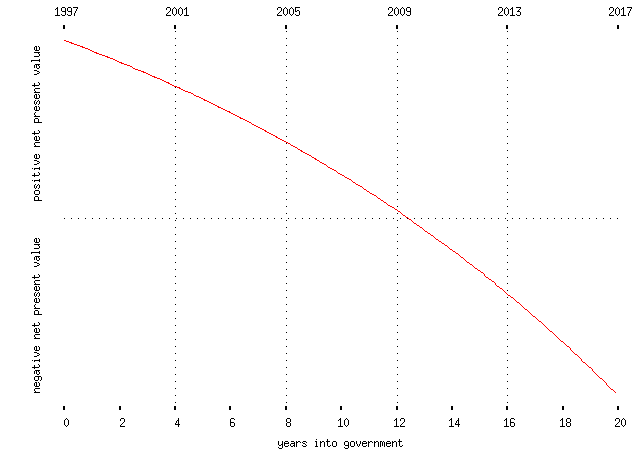
Consider a completely toy model. Suppose that you are in charge of one of two major political parties. Suppose that you derive benefit +b per unit time from being in power, benefit -b from the other major party being in power, and, on average, 0 from a hung Parliament where policy-making is by deals between the two major parties and other smaller parties. Suppose further that, owing to (waves hands) demographic change and stuff, power alternates between the two major parties, with each being in power for time T before being swept away to make space for a period of T under the other government. Finally, suppose that at any point during this cycle when you are in power, you can pull the plug on the whole thing and replace it with a proportional electoral system which will ensure a permanent hung Parliament. Would it ever be rational to reform the electoral system?
Well, this is very simple to answer. Obviously at any given point the net present value to a party in power from the expected future alternation of power between it and its mortal enemy can be obtained by simple discounting; whereas the net present value of eternal shifting coalition government is always zero. Suppose that each government lasts 20 years and politicians discount future power at a rate of 5% per annum. For a rational government, the net present value of preserving the current system, compared to bringing in a proportional one, reaches zero about twelve years into a Government's lifetime:
In unrelated news, I hear that the Labour Party has inserted a pledge to review the electoral system during its third term into its manifesto.


Comments
Posted by Nick, Friday, 22 April 2005 00:46 (link):
OK, the answer to the trivia question is islands, of course.
On the main point of the post, that's an interesting system and one that certainly makes for interesting discussion. One issue does spring to mind, though - the question of free votes, when each MP supposedly votes according to their conscience rather than the party whip. Should they then have one vote each, as they're not voting according to party rules? (Or another allocation entirely, perhaps, treating each MP as an independent)
However, the problem, if you accept that, is that there's then an incentive for the largest party to get votes scheduled as free votes, thus improving the chance for it to get a majority of votes from its own MPs alone.
Posted by Francis Irving, Friday, 22 April 2005 04:01 (link):
According to the speaker, all votes are free votes. Seriously, this isn't a problem, and even if it were, it would be one you couldn't solve, as the party whip is currently a private matter between each whips office and MPs. Actually, it is worse than that. Even if you legislated for the whip to be published, how could you tell the office wasn't whipping when it claimed it was a free vote? Whipping is subtle. e.g. Asking a rebel MP to stay on holiday next week, please.
So i say you give them their full allocation all the time.
On a related note, the Electoral Reform Society had a leaflet in Prospect magazine this month. They run the makeyourvotecount thing. What do you think of them as a group?
Posted by Chris Lightfoot, Friday, 22 April 2005 09:34 (link):
I know almost nothing about the Electoral Reform Society. Make My Vote Count (I get confused by pronouns in domain names too) favours,
and notes that,Well, that's all very well, though I can't see that AV+ has any advantage over my proposed scheme (other, perhaps, than having a name). In particular AV+ is much more complicated than my proposal, since each individual has to cast >1 vote.
(I should probably also say that, following this web log's policy of being strictly non-party-political, I have no opinion whatever on whether electoral reform is desirable.)
Posted by Francis Irving, Friday, 22 April 2005 13:07 (link):
OK, so what should we call your system? One party one vote hardly is catchy... "Proportional parliament". Anyone got any ideas?
Posted by Chris Lightfoot, Friday, 22 April 2005 14:34 (link):
Proportional First-Past-the-Post?
Posted by Chris Lightfoot, Friday, 22 April 2005 09:27 (link):
Realistically I'd say no, partly for the reason you cite, but also because most people do seem to vote on the basis of party affiliation. Plus, it's much easier if MPs carry their initial allocation with them throughout a Parliament.
Posted by Matthew, Friday, 22 April 2005 08:32 (link):
What about if a party gets no seats, and 15% of the vote? Not likely perhaps, but it would be if the Labour Party split into Regional Parties for the election.
Posted by Anthony, Friday, 22 April 2005 09:06 (link):
I was going to say what Matt said, but he beat me to it. So instead I'll just say "They're both islands".
Posted by Chris Lightfoot, Friday, 22 April 2005 09:55 (link):
Clearly I should have asked a different trivia question! (Actually I only discovered this when I was doing the plots of constituency size -- I was surprised at how large the range was. I should have realised that it'd be a well-known factlet.)
Is the supposed explanation for the different sizes of electorates in Labour and Conservative seats correct? Actually the plot above is misleading in that it's from the actual 2001 election result with the old Scottish boundaries, which exaggerates the effect slightly. But taking account of the new boundaries doesn't make the effect disappear: on implied results, the median Labour constituency has 67,000 electors and the median Tory 72,000.
Posted by Francis Irving, Friday, 22 April 2005 13:08 (link):
I didn't know it, but I immediately guessed it when you asked it. It is quite easy to deduce.
Posted by dsquared, Friday, 22 April 2005 14:23 (link):
I suspect that Canvey Island is the smallest. The Isle of Wight is two constituencies; it's not Ynys Mon that's the largest is it?
Posted by Chris Lightfoot, Friday, 22 April 2005 14:33 (link):
No, the Isle of Wight is one constituency, electorate 106,305; the smallest is Na h-Eileanan An Iar (the Western Isles), electorate 21,884. By the looks of things, Canvey Island is part of Castle Point, electorate 68,108.
Posted by Chris Lightfoot, Friday, 22 April 2005 14:35 (link):
Oh, and Ynys Mon is quite large, by these standards -- 53,117. (And, yes, quoting five significant figures is moronic -- I'm just cutting-and-pasting them out of the data file.)
Posted by Chris Lightfoot, Friday, 22 April 2005 09:38 (link):
If they get no seats they get no seats. If you accept the `elections are referendums on the previous government' position, then that's logically necessary: somebody has to be in a position to sack each MP. It certainly seems no worse a constraint than an arbitrary threshold of 5% of the vote.
But perhaps I'm misunderstanding your hypothetical Labour Party example....
Posted by Matthew Turner, Friday, 22 April 2005 09:53 (link):
I"f they get no seats they get no seats"
Don't you need then to make the vote-shares, the vote shares of parties that got seats? It might be better to have a few MPs who are 'created' in this case to account for the 0 seat but x% parties.
Posted by Chris Lightfoot, Friday, 22 April 2005 09:59 (link):
But that just changes the multiplying constant a bit. You might want to do this to arrange that the sum of all MPs' voting weights is 646 (which my above scheme doesn't quite, in fact) but that's only important for neatness of arithmetic.
Posted by Matthew Turner, Friday, 22 April 2005 10:04 (link):
Chris,
On the marginals point is the point that it's not particuarly important nationally if you lose a marginal by 1 vote or win it (though obviously your candidate will think differently!).?
Posted by Chris Lightfoot, Friday, 22 April 2005 10:16 (link):
Yes, roughly. Specifically: imagine a party which could win a certain constituency if it disposed a certain amount of campaigning resource there. If it does so it is likely to increase its share of the vote in the constituency, but it might also increase turnout generally, so that the other parties get more votes too. So campaigning more in a particular constituency could also benefit the incumbent's party, even if they lose that seat. Indeed, ceteris paribus, existing parties don't have any incentive to win more seats -- they can make do with the same number of MPs all the time, and campaign nationally to increase their share of the vote everywhere.
Thing is, I'm not really sure this is a disadvantage. If an individual MP is particularly craven or hopeless, their constituents can gang up and turf them out of the Commons; and if they're particularly good, keep them in office despite a national swing, as under the present system. Otherwise parties' power in the Commons varies directly as their support in the country varies. Individuals who want to be MPs do have to campaign locally, but that's just a natural outcome of local ambition. The scheme seems to me to preserve all the desirable attributes of our current system, while adding desirable attributes from other possible ones.
Posted by Matthew Turner, Friday, 22 April 2005 10:46 (link):
Yes, I think you're right.
I like the system then. Shame you say there's no chance of it happening.
The only other thoughts I have are a) is there any incentive to have more MPs for reasons other than divisions, ie media coverage or committees? b) would it worth the while of, say, the Ulster Unionists standing across the country, rather than just in N.I, in an attempt to pick up another MP?
Posted by Matthew Turner, Friday, 22 April 2005 11:02 (link):
And one other thing. If a party with reasonably widespread but shallow support, say the Greens, managed to elect one MP, he'd had perhaps 3% of the votes. That could make him quite powerful, no?
Posted by Chris Lightfoot, Friday, 22 April 2005 11:29 (link):
Yes -- about twenty seats' worth, in that example. Is this disastrous? I don't think so. It's not uncommon for small parties to be very effectively whipped, and in that respect they are no different from a single MP casting a large vote. Of course, this hypothetical Green MP would have an interest in increasing the Green vote in the country but might not be that keen on getting other Green MPs elected (assuming that personal lust for power is more important to him than loneliness in the Commons), which is a bit bizarre, but since other constituency Green parties wouldn't share this incentive that doesn't seem too bad either.
Posted by lth, Monday, 25 April 2005 11:48 (link):
But Greens do have a fair amount of voters, but no MP in Parliament at the moment. Your proposed system relied on someone, somewhere, electing a Green MP in order for them to get into Parliament - and yet, with 3% of the UK vote, you indicate that they would have a sizeable influence in Parliament. How do you square this circle?
Posted by Chris Lightfoot, Monday, 25 April 2005 20:58 (link):
I don't think it needs squaring, to be honest. Unlike the present system, my proposal would give that single Green MP as power in the Commons commensurate with the total Green support in the country; and if they are not able to get a single MP elected, the Green Party would be no worse off than it is now.
Posted by Chris Lightfoot, Friday, 22 April 2005 11:34 (link):
Well, there are lots of practical reasons to want lots of MPs. For instance, if committees are constituted according to party support, it's worth having lots of MPs so that each one isn't too weighed down with committee work. As for NI and nationalist parties... hmm. You could imagine that it might be worth (say) the SNP putting up candidates in bits of England with large ex-pat Scottish communities, not because those candidates would win seats, but to increase their share of the vote and therefore the power of their elected MPs. It might in fact be worth appending to each ballot paper a list of `other parties standing in the election but not putting up candidates in this constituency' for the same purpose, so that everyone can vote for either a specific candidate, or a national party if no candidate is standing.
Posted by Matthew Turner, Friday, 22 April 2005 13:07 (link):
One thing it wouldn't do is correct the regional imbalances the current system throws up. There would still be no Tory representation in Scotland for instance. The only improvement Scottish Tories would get was the knowledge that Tory MPs in the rest of the country were more empowered by their votes, so perhaps they would pay more attention to them?
Posted by Chris Lightfoot, Friday, 22 April 2005 14:45 (link):
OK, it's harder to defend this one as a feature not a bug, but FPTP advocates manage to, so here goes: if constituencies in Scotland don't like the Tories enough to elect a Tory MP, then they shouldn't have one. At least under PFPTP (new name: see above) those Scottish Tory votes aren't entirely wasted.
Posted by Sam Evans, Wednesday, 27 April 2005 23:41 (link):
How about CSSD in combination with your proportional MP scaling? If you weight MP's according to their number of rank 1 votes, you might get something interesting.
Posted by Andy Cooke, Friday, 22 April 2005 14:41 (link):
The pairing whips would really have to earn their pay :-)
For a close order stab, 2 Labour should be paired with 1 Con, but that favours Con a little (0.06 votes/seat). If Labour get really picky on a close vote, they might push for a 25:13 pairing ratio (favours Labour by 0.015 votes/seat). For really critical votes, the whips could have a 126:65 quota.
For Lab/Lib pairs, the best close order stab would be 7 Labour to 2 Lib Dems (favours Labour by 0.07 votes/seat). For important votes they could go to 25:7 ratio (within 0.002 votes/seat).
Posted by dsquared, Friday, 22 April 2005 15:36 (link):
Under Chris's proposal, it would possibly make sense to ban pairing, which I have long believed should be done anyway. Not having pairing would force governments to prioritise their legislation, and make it unbearably difficult to pass bills odious to large sections of the public.
Posted by Chris Lightfoot, Friday, 22 April 2005 20:29 (link):
I don't think I'd advocate banning pairing. In fact I think it creates scope for a bit of remedial adult education, as Andy points out. More generally, if MPs are able, amongst themselves, to come to pairing arrangements, that doesn't seem to me something which ought to be regulated constitutionally. It is of course true that arbitrary rational voting weights make achieving an accurate pairing more complex than it is in the present Commons.
Posted by Matthew Turner, Friday, 22 April 2005 15:36 (link):
I think that's what I meant in my first post. If (say) the Scottish Conservatives wanted greater representation, they would be better off forming their own separate party. Then they would have got one seat with about six seats voting power (based on their 1.36% of the popular vote), rather than one seat with 1.26 voting power.
Posted by Chris Lightfoot, Friday, 22 April 2005 20:16 (link):
... or, to ask the more general version of this question, ``when is it rational for a candidate to leave their party?''
Well, if the only consideration is to maximise the MP's voting weight, then any MP who expects their vote to exceed the mean of votes for all their party's candidates (victorious and not) would be better of as an independent. Obviously every time that an MP with support in excess of the mean leaves the party, the mean vote of the party's candidates declines, and even more candidates will want to leave.
So on the face of it political parties are unstable in PFPTP. Quelle désastre!
But why are political parties stable anyway? Wouldn't all MPs be better off as independents, untramelled by party discipline? Presumably as with companies, the answer is something -- perhaps quite a lot -- to do with transaction costs. (As a specific example, parties are more effective at raising funds than individual candidates, which could benefit candidates in marginal seats -- where they are most likely to be elected by a large absolute vote -- and have various other benefits they can bring their members by collective action.) Presumably under PFPTP a few charismatic MPs would conclude that they are better off as independents or as members of tiny parties, and jump ship. But that's hardly unknown under FPTP, either. (OK, some of those examples are a little irrelevant. But the point stands.)
Posted by Nick, Friday, 22 April 2005 15:42 (link):
I think I may have discovered a flaw with the system - well, it's not specifically your system, more a carryover from FPTP. But, in terms of accountability within a constituency, PFPTP runs up against the same problems as FPTP - and perhaps enhances the problem - in that the individual voter is given a choice of which party to support, but no choice over who the representative of that party is. As someone once ddescribed it - FPTP is just party lists with single seat constituencies, though at least PFPTP balances out the end result.
To clarify, imagine that you are a strong Conservative supporter in Tatton in 1997 under this system. For obvious reasons, you don't want to vote for Neil Hamilton, but if you choose to support Martin Bell instead not only are you reducing Conservative representation by one - as happened under the old system - but you are also reducing the number of votes given to the Conservative party in total and thus reducing the amount of power they have.
Like I said, this is more a feature of original FPTP that you've carried over - and I don't know what the effect of a mass Tatton-sized switch would have on overall party vote share - but the problem remains that if the individual's party of choice chooses a candidate they don't approve of, then they're stuffed.
Posted by Mark, Saturday, 23 April 2005 07:15 (link):
Actually, Chris's system is a lot better than FPTP on this - while the anti-Hamilton Tory might be upset that he isn't giving his vote to the Tories as a party, he can at least draw comfort from the fact that unseating a Tory MP will not by itself reduce the Tory party's real parliamentary strength.
Posted by Roy Badami, Saturday, 23 April 2005 12:56 (link):
This is, of course, the case that the various top-up systems handle nicely.
Experience with these shows that many electors actually do cast their consituency and top-up votes for different parties, though what's less clear to me is how many voters have made a rational decision to do so and how many have simply become confused as to how the electoral system works, and misunderstand the effect that such a vote will have.
This point is crucial in evaluating how problematic Oggie's objection to AV+ is, namely that it makes the voting process more complex. Does it make it too complex?
Posted by Mark, Saturday, 23 April 2005 07:17 (link):
Re: the party in power never agreeing to electoral reform, it's worth noting that the only way electoral reform has been likely to get through is via the Liberal Democrats being involved in a coalition government: the Liberal Democrats stand to gain from PR, and can use their coalition leverage to bring it in.
Posted by Chris Lightfoot, Saturday, 23 April 2005 18:51 (link):
Well, that was rather what the last bit of my post was on, but it seems largely to have been ignored by my readers....
Posted by Roy Badami, Saturday, 23 April 2005 13:54 (link):
What do you think of PR-Squared, BTW?
It has some similarities with your approach, though it fixes the proportionality is a different way...
Posted by Roy Badami, Saturday, 23 April 2005 15:13 (link):
Doh! Ok, I missed the fact that PR-Squared allocates seats in proportion to the square of the vote shares, but you could obviously do something similar without the squaring...
Posted by Chris Lightfoot, Monday, 25 April 2005 21:36 (link):
PR-Squared is indeed interesting. (In fact, I would strongly recommend anyone who has not done so to take a look around all of Julian Wiseman's site; there's much of interest there, including this interesting essay on How To Blow Up The European Single Currency. I'm not, by the way, in a position to judge the plausibility of the latter.)
As you say, the underlying notion of PR-Squared -- allocating MPs to constituencies by a global minimisation of some plausible utility function, in his case the number of voters who did not vote for the party of their local MP -- could be used to allocate seats in a straight PR system. However, I am suspicious of such systems on the grounds of their opacity. How do you explain to the -- possibly rioting -- populace how it is that they have wound up with the MPs they have been allocated? And how do you prove that the outcome which has occured is, indeed, a global minimum?
The discussion of byelections is also of interest:
This particular problem does not affect PFPTP, because a party which could win a byelection would also be able to win a seat at a general election. Other problems no doubt remain....
(As an aside, the OED says `byelection' or `by-election'. Surely `bye-election' cannot be correct?)
Posted by Roy Badami, Wednesday, 11 May 2005 23:39 (link):
The bit about the Euro is interesting, though AFAICS much (though not all) of the analysis would be relevent to any currency; the Euro is just the most plausible target.
As for bye-elections, I confess that until very recently I, too, believed that was the spelling. Something like byelaws, I guess...
Incidentally, any chance of a better way of spotting when comments have been replied to? It's easy to miss a reply unless you're keeping up with the 'recent comments' section (and there doesn't seem to be any way of going back beyond the last six). I suppose e-mail notifications would be problematic, since e-mail addresses aren't verified...?
-roy
Posted by Matthew, Saturday, 23 April 2005 17:46 (link):
If you look at the numbers I'm not sure how much Labour really does gain from the fact its seats are smaller, because it's somewhat cancelled out by Labour's candidates being better winners (taking 55% in the seats they won to the Tories 47%). So in votes it's not that great a difference, with Labour's winning candidates getting 20,013 votes each on average, with the Tories' getting 21,402.
So a bias, but it's not large. If you 'corrected' each MPs vote to represent the relative size of his winning vote, it would make a miniscule difference to the result (about 4 seats to the Conservatives from Labour). If you corrected it for the size of the constituency, it would take about 9 seats off Labour.
The Conservatives' problem is not so much the constituencies, it's that they come second too often and you get nothing for coming second. Which of course is the great advantage of your system.
Posted by Matt Freestone, Wednesday, 24 August 2005 13:12 (link):
I just wondered if the analysis of NotApathetic comments was going to happen? Or were there just not any useful conclusions to be drawn from the comments on the site (even so I'd quite like to know, having spent time delivering leaflets and correlating and stuff)?
Posted by Chris Lightfoot, Friday, 26 August 2005 13:12 (link):
Yes, it will -- we've been much busier than expected and the schedule has slipped quite a bit from our original plan. Sorry about the continuing delay....
Post a new comment.
Comments copyright (c) contributors and available under a Creative Commons License. See also the comments policy.